


How do multi-turn absolute encoders reshape the precise control logic of industrial automation?
Release Time : 2026-06-16
Against the backdrop of the rapid development of industrial automation and intelligent manufacturing, rotary encoders, as core sensors connecting mechanical motion and digital control systems, directly determine the control accuracy and operational stability of equipment. Among the many types of encoders, absolute encoders, with their unique signal output method, are gradually replacing traditional incremental encoders and becoming the preferred choice for high-end equipment manufacturing. In particular, absolute encoders, combining a solid shaft structure with multi-turn counting functionality, have become indispensable "intelligent eyes" in servo systems, robot joints, and precision CNC machine tools due to their excellent mechanical adaptability, data memory capabilities, and extremely high reliability. They are not merely simple angle measuring elements, but the cornerstone ensuring precise positioning and synchronous control of automated production lines under complex working conditions.
The core advantage of an absolute encoder lies in its ability to memorize "absolute positions." Unlike incremental encoders, which require a cumbersome zeroing operation after a power outage and restart to determine their current position, each position within an absolute encoder corresponds to a unique digital code. This means that regardless of the equipment's state, even in the event of an unexpected power outage or system malfunction, the encoder can accurately remember the current mechanical position and immediately output the accurate angle value upon power-up. This feature greatly simplifies the initialization process of the mechanical system, eliminates the risk of collisions caused by zeroing operations, and significantly improves the operating efficiency and safety of production equipment. For modern production lines that require continuous operation and cannot tolerate frequent shutdowns and resets, this instant response capability is undoubtedly crucial.
Building on this foundation, the emergence of multi-turn absolute encoders further expands their application boundaries. Ordinary single-turn absolute encoders can only record the angular changes of the rotating shaft within a 360-degree range. Once the rotation exceeds one revolution, the count resets to zero, making it impossible to detect the specific number of revolutions. Multi-turn absolute encoders, however, integrate a precise gear reduction mechanism or electronic counting module, enabling them to accurately accumulate the number of revolutions while recording the angle of a single revolution. This gives the encoder a very large measurement range, easily handling applications requiring long-distance linear displacement measurement or large-range rotation control. Whether controlling the precise stopping of a lifting platform or monitoring the material length of a winding machine, the multi-turn absolute encoder provides continuous and uninterrupted position feedback, ensuring the continuity and accuracy of long-stroke motion control.
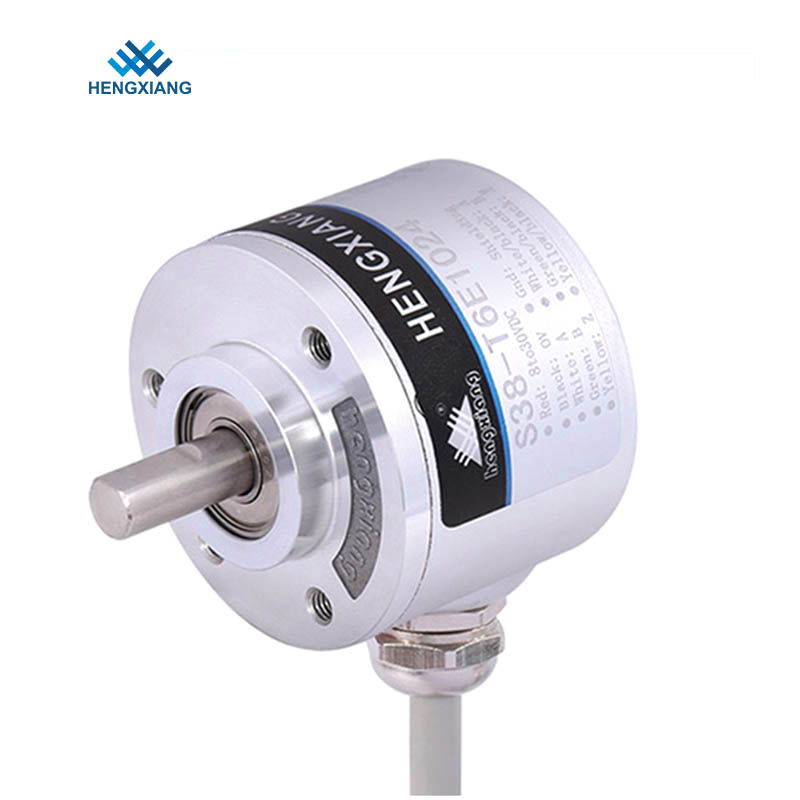
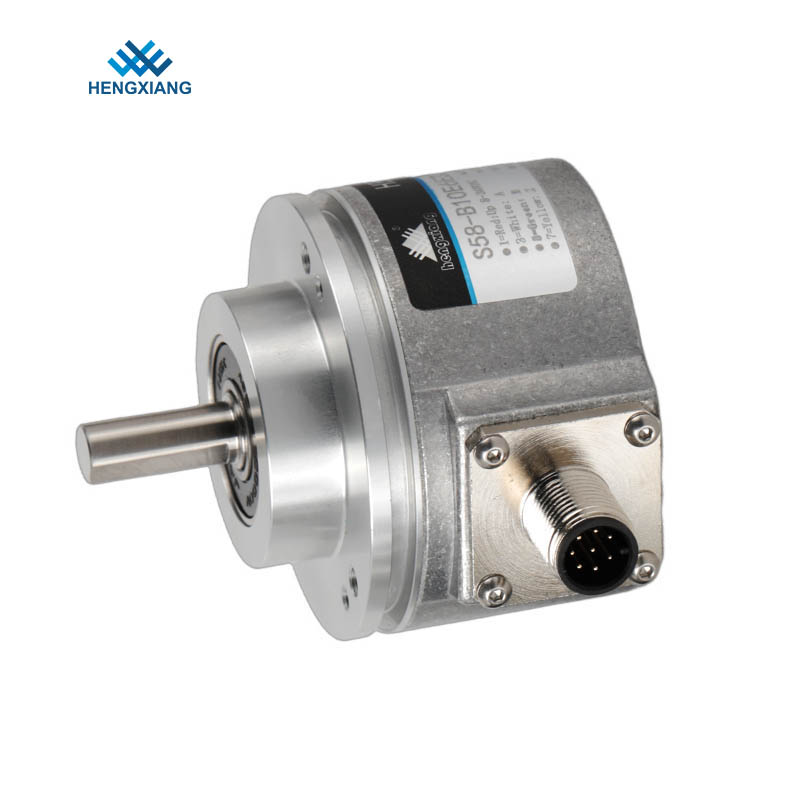
The solid shaft structure design gives the encoder excellent mechanical adaptability and ease of installation. In industrial settings, motor shafts or load shafts vary widely in shape and size. Solid shaft encoders typically use flange mounting or bushing connections, allowing for tight fit with various standard or non-standard drive shafts. This rigid connection method is not only simple and robust, but also effectively resists strong mechanical vibrations and impacts, preventing measurement errors caused by loosening or slippage of the coupling. Especially in harsh conditions such as mining machinery and port cranes, the solid shaft structure, with its excellent overload resistance, ensures that the sensor maintains a stable signal output even in dusty, oily, and vibrating environments, providing a solid physical guarantee for the long-term stable operation of the equipment.
In summary, the multi-turn absolute solid shaft encoder, by integrating three major technological advantages—absolute position memory, multi-turn counting expansion, and rigid solid shaft connection—perfectly addresses the high standards of position detection required in industrial automation. It not only improves system control accuracy and response speed but also reduces maintenance costs and failure risks. With the deepening of Industry 4.0, this intelligent sensing element, integrating high-precision sensing and high-reliability design, will undoubtedly play its core value in a wider range of fields, driving the manufacturing industry towards greater intelligence and precision.
The core advantage of an absolute encoder lies in its ability to memorize "absolute positions." Unlike incremental encoders, which require a cumbersome zeroing operation after a power outage and restart to determine their current position, each position within an absolute encoder corresponds to a unique digital code. This means that regardless of the equipment's state, even in the event of an unexpected power outage or system malfunction, the encoder can accurately remember the current mechanical position and immediately output the accurate angle value upon power-up. This feature greatly simplifies the initialization process of the mechanical system, eliminates the risk of collisions caused by zeroing operations, and significantly improves the operating efficiency and safety of production equipment. For modern production lines that require continuous operation and cannot tolerate frequent shutdowns and resets, this instant response capability is undoubtedly crucial.
Building on this foundation, the emergence of multi-turn absolute encoders further expands their application boundaries. Ordinary single-turn absolute encoders can only record the angular changes of the rotating shaft within a 360-degree range. Once the rotation exceeds one revolution, the count resets to zero, making it impossible to detect the specific number of revolutions. Multi-turn absolute encoders, however, integrate a precise gear reduction mechanism or electronic counting module, enabling them to accurately accumulate the number of revolutions while recording the angle of a single revolution. This gives the encoder a very large measurement range, easily handling applications requiring long-distance linear displacement measurement or large-range rotation control. Whether controlling the precise stopping of a lifting platform or monitoring the material length of a winding machine, the multi-turn absolute encoder provides continuous and uninterrupted position feedback, ensuring the continuity and accuracy of long-stroke motion control.
The solid shaft structure design gives the encoder excellent mechanical adaptability and ease of installation. In industrial settings, motor shafts or load shafts vary widely in shape and size. Solid shaft encoders typically use flange mounting or bushing connections, allowing for tight fit with various standard or non-standard drive shafts. This rigid connection method is not only simple and robust, but also effectively resists strong mechanical vibrations and impacts, preventing measurement errors caused by loosening or slippage of the coupling. Especially in harsh conditions such as mining machinery and port cranes, the solid shaft structure, with its excellent overload resistance, ensures that the sensor maintains a stable signal output even in dusty, oily, and vibrating environments, providing a solid physical guarantee for the long-term stable operation of the equipment.
In summary, the multi-turn absolute solid shaft encoder, by integrating three major technological advantages—absolute position memory, multi-turn counting expansion, and rigid solid shaft connection—perfectly addresses the high standards of position detection required in industrial automation. It not only improves system control accuracy and response speed but also reduces maintenance costs and failure risks. With the deepening of Industry 4.0, this intelligent sensing element, integrating high-precision sensing and high-reliability design, will undoubtedly play its core value in a wider range of fields, driving the manufacturing industry towards greater intelligence and precision.