


How can a bearing-ess magnetic encoder define precise rotation in an invisible way?
Release Time : 2025-11-20
At the heart of modern industrial automation and high-end equipment operation, the perception of position, speed, and angle must be almost intuitively precise. Traditional mechanical sensing methods have gradually revealed their limitations due to wear, vibration, and space constraints. However, the emergence of bearing-ess magnetic encoders has redefined the boundaries of rotational feedback with non-contact measurement, compact structure, and high robustness. It has no ball bearings and does not rely on optical components; it captures every minute movement of the rotating shaft solely through changes in the magnetic field, becoming an invisible yet indispensable "eye of rotation" in applications such as motors, robots, medical equipment, and semiconductor manufacturing.
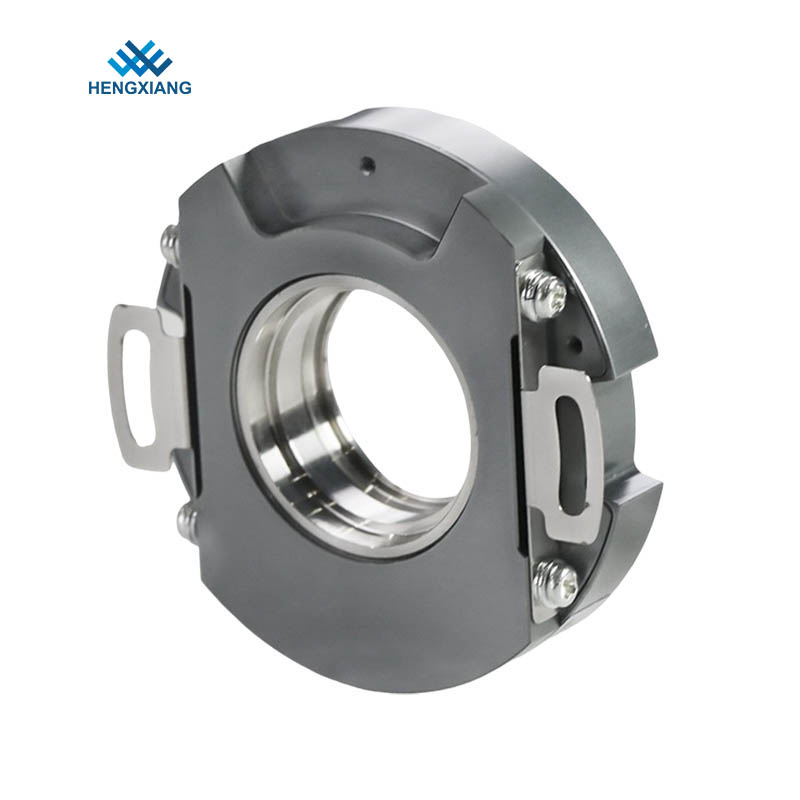
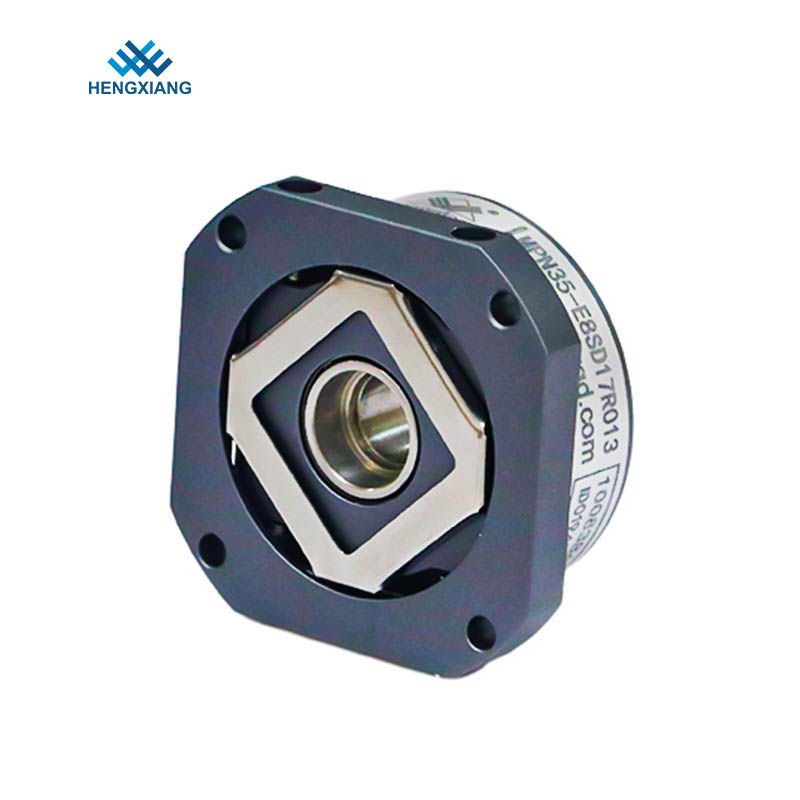
The core breakthrough of the bearing-ess magnetic encoder lies in its "decentralized" structural philosophy. It abandons the built-in bearing support required by traditional encoders, directly fitting onto the outside of the measured rotating shaft, forming a truly hollow through-shaft design. This layout not only significantly simplifies the installation process—eliminating the need for precise alignment or additional support structures—but also eliminates the lifespan bottleneck and maintenance requirements caused by bearing wear. Meanwhile, the hollow shaft provides through channels for cables, air passages, or cooling pipes, freeing up valuable internal resources in space-constrained integrated systems (such as collaborative robot joints or endoscope drive modules).
Its working principle is based on magnetoresistive or Hall effect. A permanent magnet is fixed to the rotating component, while a magnetic sensor array is stationary inside the housing. As the shaft rotates, the magnetic field direction changes accordingly, and the sensors analyze the magnetic field vector in real time, outputting a high-resolution position signal. The entire process involves no physical contact and no frictional loss, maintaining stable output even in oily, dusty, humid, or high-vibration environments. Compared to easily contaminated optical encoders, magnetic encoders exhibit stronger environmental adaptability, especially suitable for harsh conditions such as metallurgy, mining, and food processing.
Accuracy and reliability are not mutually exclusive but rather unified through advanced algorithms. Modern bearing-ess magnetic encoders generally integrate temperature compensation, signal filtering, and self-calibration functions to effectively suppress external electromagnetic interference and temperature drift. Some high-end models employ multi-pole magnetic rings and interpolation technology to achieve sub-angular resolution without increasing mechanical complexity. Its output interface is compatible with mainstream industrial protocols, allowing seamless integration with servo drives, PLCs, or motion controllers, forming a solid foundation for closed-loop control.
The breadth of its applications testifies to its technological value. In servo motors, it provides real-time rotor position feedback, ensuring precise torque output; on CNC rotary tables, it guarantees the synchronization accuracy of multi-axis linkage; in the rotating supports of medical CT equipment, it supports long-term continuous scanning with zero maintenance; and in wind turbine pitch systems, its shock resistance and weather resistance withstand extreme field tests. Behind every smooth start-up and shutdown, behind every degree of precise positioning, lies the silent contribution of the magnetic encoder.
A deeper significance lies in representing an engineering trend of "lightweight sensing." Removing bearings, simplifying the structure, and reducing size do not sacrifice performance; instead, they improve the overall reliability and integration of the system. This "less is more" design wisdom is a microcosm of high-end manufacturing moving from redundancy to lean manufacturing.
The existence of a bearing-ess magnetic encoder proves that the most sophisticated sensing does not necessarily rely on the most complex structure. Using magnetic fields as its language and a hollow interior as its enclosure, it transforms the mysteries of rotation into clear electrical signals. Within this small space of magneto-electric conversion lies the relentless pursuit of "reliability, simplicity, and efficiency" by modern industry—enabling machines not only to move, but also to "sense" how they move, thus moving towards a truly intelligent future.