


How do bearing-ess magnetic encoders (hollow shaft type) achieve high-precision position feedback and system integration optimization?
Release Time : 2025-11-13
With increasingly stringent requirements for position detection accuracy, response speed, and reliability in industrial automation, robotics, servo motors, and precision transmission equipment, bearing-ess magnetic encoders (hollow shaft type), with their unique non-contact sensing principle, compact structure, and excellent environmental adaptability, are becoming an ideal replacement for traditional photoelectric encoders and mechanical bearing-type magnetic encoders. They not only eliminate the lifespan limitations caused by mechanical wear but also greatly improve installation flexibility and system integration efficiency through the hollow shaft design, providing a stable, accurate, and maintenance-free position feedback solution for high-end motion control.
The core advantage of the bearing-ess magnetic encoder lies first in its completely non-contact measurement mechanism. The device consists of a magnetic sensor array fixed to the housing and a permanent magnet ring mounted on a rotating shaft; there is no physical connection between the two, and angular displacement is sensed only through changes in the magnetic field. This design completely avoids mechanical failure sources such as bearing wear, lubrication failure, and vibration loosening, significantly extending service life, and is especially suitable for dynamic operating conditions involving high speeds (up to 30,000 rpm and above), high acceleration, or frequent start-stop cycles. Simultaneously, the frictionless structure reduces system inertia, improving response speed and energy efficiency.
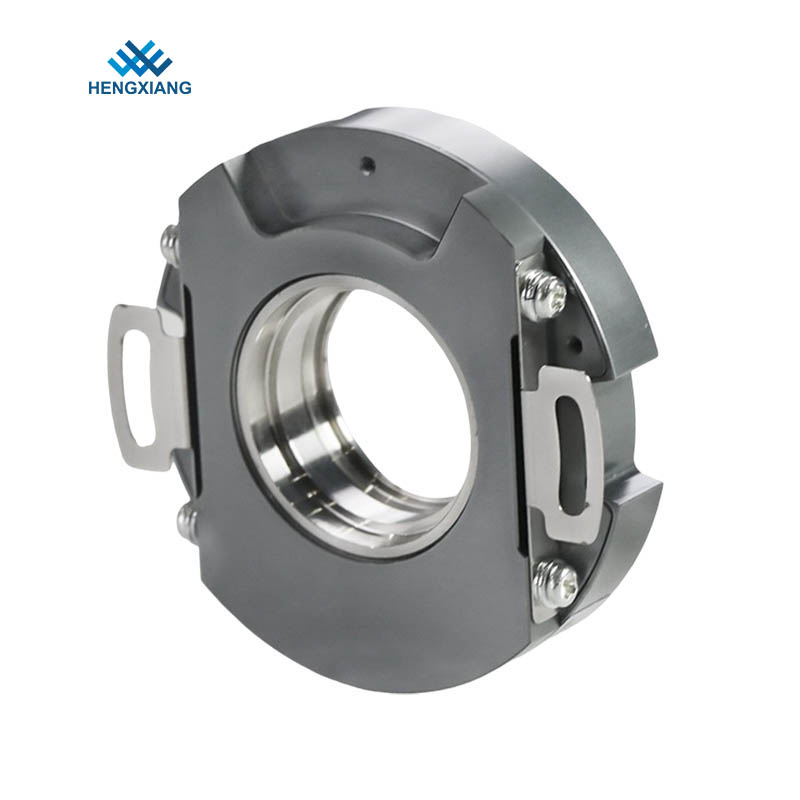
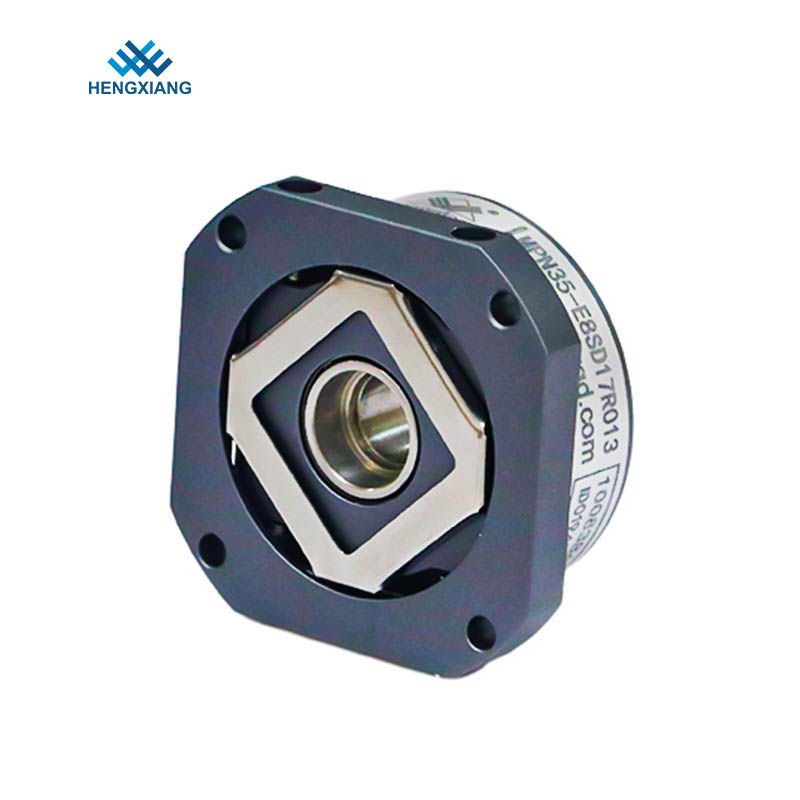
The hollow shaft structure further enhances its engineering practicality. The center through-hole design allows the motor shaft, lead screw, cable, or pneumatic/hydraulic lines to pass directly through the encoder body, greatly simplifying the mechanical layout and saving valuable axial and radial space. In compact devices such as servo motors, direct-drive rotary tables, or multi-axis robot joints, this "through-shaft installation" feature avoids complex coupling or extension shaft designs, reduces assembly errors and accumulated tolerances, and improves overall system rigidity and positioning accuracy. Installation only requires fitting the magnetic ring onto the shaft end and locking it, eliminating the need for precise alignment and significantly shortening the commissioning cycle.
Performance is equally outstanding. Modern bearing-essence magnetic encoders employ high-resolution Hall effect or AMR (anisotropic magnetoresistive) sensors, coupled with advanced signal processing algorithms, achieving a single-turn resolution of up to 21 bits (2,097,152 pulses/revolution) and a repeatability of ±0.01°, meeting the demands of high-dynamic trajectory tracking. Thanks to digital filtering and temperature compensation technology, it maintains stable output over a wide temperature range of -40℃ to +125℃; it possesses strong anti-electromagnetic interference capabilities, allowing reliable operation in high-voltage environments such as those of frequency converters and servo drives. Some models support BiSS C, SSI, ABZ incremental or analog outputs, seamlessly integrating with mainstream PLCs and motion controllers.
Environmental adaptability far surpasses traditional photoelectric encoders. The absence of optical components means it is unaffected by oil, dust, condensation, or strong light, enabling stable operation in harsh environments such as foundries, food processing plants, and outdoor construction machinery. The all-metal sealed housing (IP67/IP68 protection rating) resists high-pressure washing and corrosive gas corrosion, truly achieving "maintenance-free" long-term use.
Ultimately, the value of the bearing-ess magnetic encoder (hollow shaft) lies not only in "measuring angles," but also in its simple yet robust architecture, which redefines the reliability boundaries of position sensing. When a collaborative robot precisely replicates micron-level movements in a cleanroom, or when a wind turbine's yaw system continuously tracks wind direction during a sandstorm, this encoder silently safeguards the integrity of the control loop. In an era where intelligent manufacturing is moving towards high dynamism, high reliability, and high integration, the bearing-ess magnetic encoder, with the power of magnetism, is injecting a trustworthy "position eye" into precision motion.
The core advantage of the bearing-ess magnetic encoder lies first in its completely non-contact measurement mechanism. The device consists of a magnetic sensor array fixed to the housing and a permanent magnet ring mounted on a rotating shaft; there is no physical connection between the two, and angular displacement is sensed only through changes in the magnetic field. This design completely avoids mechanical failure sources such as bearing wear, lubrication failure, and vibration loosening, significantly extending service life, and is especially suitable for dynamic operating conditions involving high speeds (up to 30,000 rpm and above), high acceleration, or frequent start-stop cycles. Simultaneously, the frictionless structure reduces system inertia, improving response speed and energy efficiency.
The hollow shaft structure further enhances its engineering practicality. The center through-hole design allows the motor shaft, lead screw, cable, or pneumatic/hydraulic lines to pass directly through the encoder body, greatly simplifying the mechanical layout and saving valuable axial and radial space. In compact devices such as servo motors, direct-drive rotary tables, or multi-axis robot joints, this "through-shaft installation" feature avoids complex coupling or extension shaft designs, reduces assembly errors and accumulated tolerances, and improves overall system rigidity and positioning accuracy. Installation only requires fitting the magnetic ring onto the shaft end and locking it, eliminating the need for precise alignment and significantly shortening the commissioning cycle.
Performance is equally outstanding. Modern bearing-essence magnetic encoders employ high-resolution Hall effect or AMR (anisotropic magnetoresistive) sensors, coupled with advanced signal processing algorithms, achieving a single-turn resolution of up to 21 bits (2,097,152 pulses/revolution) and a repeatability of ±0.01°, meeting the demands of high-dynamic trajectory tracking. Thanks to digital filtering and temperature compensation technology, it maintains stable output over a wide temperature range of -40℃ to +125℃; it possesses strong anti-electromagnetic interference capabilities, allowing reliable operation in high-voltage environments such as those of frequency converters and servo drives. Some models support BiSS C, SSI, ABZ incremental or analog outputs, seamlessly integrating with mainstream PLCs and motion controllers.
Environmental adaptability far surpasses traditional photoelectric encoders. The absence of optical components means it is unaffected by oil, dust, condensation, or strong light, enabling stable operation in harsh environments such as foundries, food processing plants, and outdoor construction machinery. The all-metal sealed housing (IP67/IP68 protection rating) resists high-pressure washing and corrosive gas corrosion, truly achieving "maintenance-free" long-term use.
Ultimately, the value of the bearing-ess magnetic encoder (hollow shaft) lies not only in "measuring angles," but also in its simple yet robust architecture, which redefines the reliability boundaries of position sensing. When a collaborative robot precisely replicates micron-level movements in a cleanroom, or when a wind turbine's yaw system continuously tracks wind direction during a sandstorm, this encoder silently safeguards the integrity of the control loop. In an era where intelligent manufacturing is moving towards high dynamism, high reliability, and high integration, the bearing-ess magnetic encoder, with the power of magnetism, is injecting a trustworthy "position eye" into precision motion.