


How do solid-shaft absolute encoders achieve zero-loss, highly stable position sensing in harsh industrial environments?
Release Time : 2025-12-26
In modern intelligent manufacturing, robotics, CNC machine tools, and energy equipment, precise, continuous, and uninterrupted feedback of rotational position is crucial for ensuring safe equipment operation and process precision. Absolute encoders (solid-shaft type)—especially those employing multi-turn solid-state sensing technology—are becoming benchmark products in industrial position detection due to their battery-free operation, strong anti-interference capabilities, unique encoding throughout the entire stroke, and mechanical robustness. They not only record the current angle but also retain multi-turn rotational information completely after a power outage, truly achieving "instant position detection upon power-on," providing a solid data foundation for complex motion control.
The core advantage of this type of encoder stems primarily from its true absolute position recognition capability. Unlike incremental encoders that rely on counting pulses to calculate position, absolute encoders output a digital signal at any given time that corresponds to a unique physical angle within the shaft system. Even in the event of a sudden power outage or communication interruption, the system can immediately obtain an accurate position after restarting without requiring a zero-return operation, avoiding the risk of malfunctions or collisions. This characteristic is particularly crucial in scenarios where zeroing is not permissible, such as large gantry milling machines, wind turbine pitch control systems, or medical robots.
Multi-turn solid-state sensing technology further expands its application boundaries. Traditional multi-turn encoders rely on gear sets or batteries to maintain the number of turns, which carries the risk of mechanical wear or battery depletion. Solid-state multi-turn encoders, however, use non-contact magnetoresistive or Hall arrays combined with intelligent algorithms to accurately track thousands of cumulative rotations without any moving parts, fusing angle and turn count information into a single absolute value output. This fully electronic design completely eliminates mechanical fatigue, significantly improving lifespan and reliability, while adapting to high-speed rotation and frequent start-stop conditions.
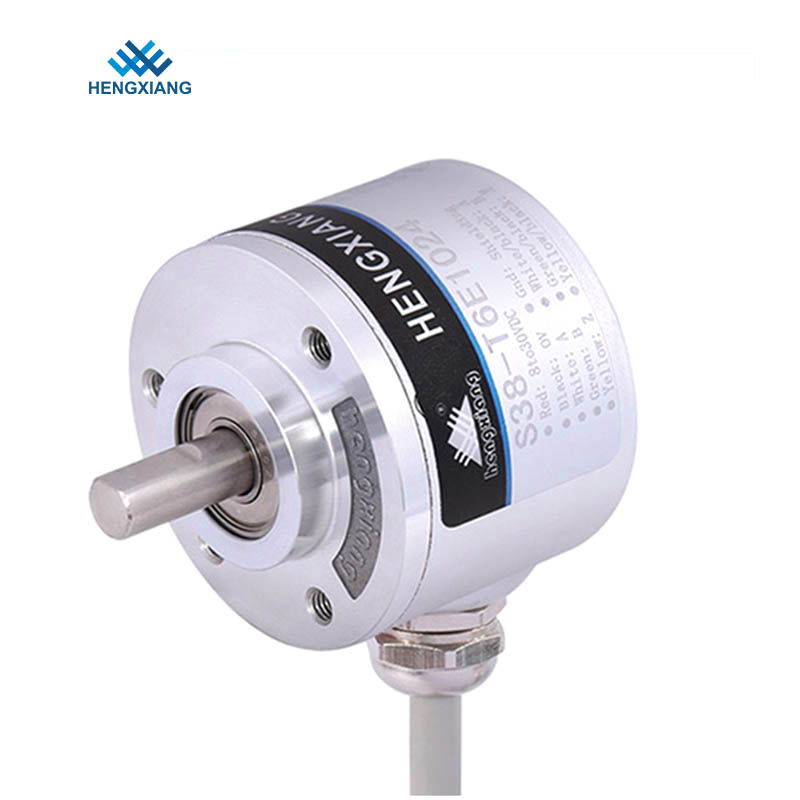
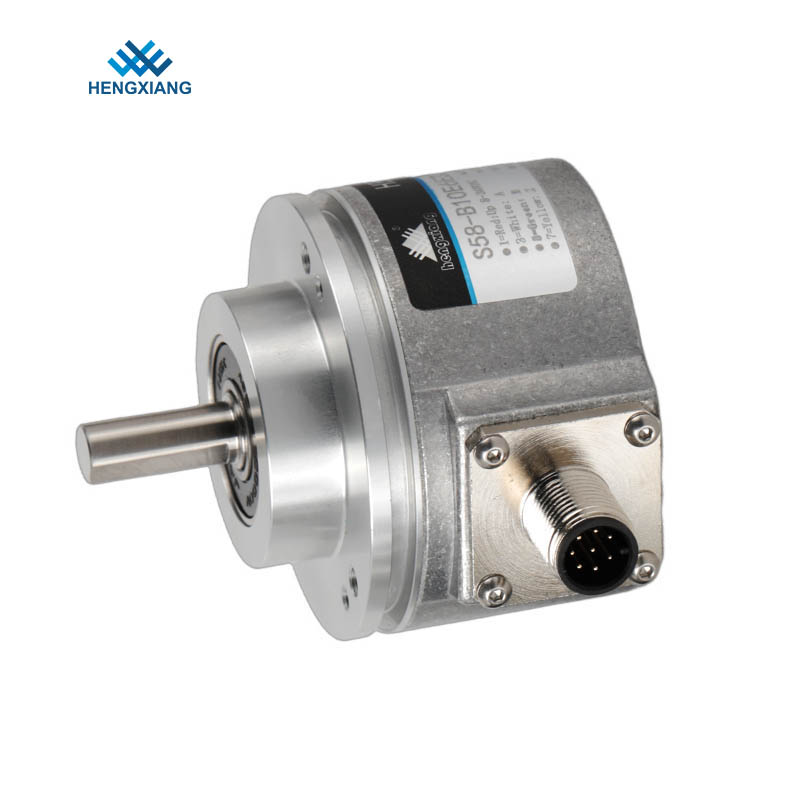
The solid shaft structure gives the encoder superior mechanical strength and installation stability. The shaft is precision-ground from high-strength alloy steel with a surface hardening treatment, allowing for direct rigid connection to the motor or drive shaft, effectively transmitting torque and resisting radial/axial loads. Compared to hollow shafts or flexible couplings, solid shafts are less prone to loosening or deformation in high-vibration and high-impact environments, ensuring long-term consistency of signal acquisition. The housing is typically made of die-cast aluminum or stainless steel, with an IP67 or higher protection rating, resisting dust, oil, moisture, and high-pressure washing, making it suitable for harsh environments such as metallurgy, mining, and food processing.
In terms of interference resistance and environmental adaptability, the absolute encoder also excels. Its internal circuitry employs a shielded design and differential signal transmission, effectively suppressing interference from strong electromagnetic sources such as frequency converters and servo drives; it has a wide operating temperature range, allowing stable operation in extremely cold or high-temperature workshops; and its output interfaces support multiple industrial protocols (such as SSI, CANopen, PROFIBUS, etc.), seamlessly connecting to mainstream PLCs and control systems.
Furthermore, its maintenance-free nature significantly reduces total lifecycle costs. The battery-free, gear-free, and brush-free design means the product requires virtually no regular maintenance; the firmware has self-diagnostic functions, reporting anomalies in real time; and its compact size facilitates installation in space-constrained areas. These advantages make it widely favored in demanding applications such as AGV navigation wheels, printing roller synchronization, and injection molding machine mold opening and closing.
When a heavy-duty robotic arm precisely positions a welding point, or when a wind turbine blade finely adjusts its angle in a storm, behind it all lies the silent, unalterable positional truth transmitted by an absolute encoder in milliseconds. It doesn't rely on external power sources for memory, yet it's more reliable than a human; it doesn't generate power, yet it makes the entire system more intelligent. Because in the underlying logic of industrial automation, true precision begins with those unwavering, consistent position signals—and this is precisely the fundamental value of a multi-turn solid absolute encoder (solid shaft).
The core advantage of this type of encoder stems primarily from its true absolute position recognition capability. Unlike incremental encoders that rely on counting pulses to calculate position, absolute encoders output a digital signal at any given time that corresponds to a unique physical angle within the shaft system. Even in the event of a sudden power outage or communication interruption, the system can immediately obtain an accurate position after restarting without requiring a zero-return operation, avoiding the risk of malfunctions or collisions. This characteristic is particularly crucial in scenarios where zeroing is not permissible, such as large gantry milling machines, wind turbine pitch control systems, or medical robots.
Multi-turn solid-state sensing technology further expands its application boundaries. Traditional multi-turn encoders rely on gear sets or batteries to maintain the number of turns, which carries the risk of mechanical wear or battery depletion. Solid-state multi-turn encoders, however, use non-contact magnetoresistive or Hall arrays combined with intelligent algorithms to accurately track thousands of cumulative rotations without any moving parts, fusing angle and turn count information into a single absolute value output. This fully electronic design completely eliminates mechanical fatigue, significantly improving lifespan and reliability, while adapting to high-speed rotation and frequent start-stop conditions.
The solid shaft structure gives the encoder superior mechanical strength and installation stability. The shaft is precision-ground from high-strength alloy steel with a surface hardening treatment, allowing for direct rigid connection to the motor or drive shaft, effectively transmitting torque and resisting radial/axial loads. Compared to hollow shafts or flexible couplings, solid shafts are less prone to loosening or deformation in high-vibration and high-impact environments, ensuring long-term consistency of signal acquisition. The housing is typically made of die-cast aluminum or stainless steel, with an IP67 or higher protection rating, resisting dust, oil, moisture, and high-pressure washing, making it suitable for harsh environments such as metallurgy, mining, and food processing.
In terms of interference resistance and environmental adaptability, the absolute encoder also excels. Its internal circuitry employs a shielded design and differential signal transmission, effectively suppressing interference from strong electromagnetic sources such as frequency converters and servo drives; it has a wide operating temperature range, allowing stable operation in extremely cold or high-temperature workshops; and its output interfaces support multiple industrial protocols (such as SSI, CANopen, PROFIBUS, etc.), seamlessly connecting to mainstream PLCs and control systems.
Furthermore, its maintenance-free nature significantly reduces total lifecycle costs. The battery-free, gear-free, and brush-free design means the product requires virtually no regular maintenance; the firmware has self-diagnostic functions, reporting anomalies in real time; and its compact size facilitates installation in space-constrained areas. These advantages make it widely favored in demanding applications such as AGV navigation wheels, printing roller synchronization, and injection molding machine mold opening and closing.
When a heavy-duty robotic arm precisely positions a welding point, or when a wind turbine blade finely adjusts its angle in a storm, behind it all lies the silent, unalterable positional truth transmitted by an absolute encoder in milliseconds. It doesn't rely on external power sources for memory, yet it's more reliable than a human; it doesn't generate power, yet it makes the entire system more intelligent. Because in the underlying logic of industrial automation, true precision begins with those unwavering, consistent position signals—and this is precisely the fundamental value of a multi-turn solid absolute encoder (solid shaft).